
Modern healthcare continues to evolve rapidly, and nuclear medicine now stands at the forefront of diagnostic innovation. It provides a unique blend of functional imaging and clinical precision, enabling clinicians to detect diseases earlier and more accurately. Moreover, nuclear medicine delivers insights into how organs function rather than simply revealing their structure, which enhances diagnostic confidence significantly.
Understanding Nuclear Medicine and Its Core Principles
Nuclear medicine is a specialized medical field that uses small amounts of radioactive substances to diagnose and treat diseases effectively. These substances, known as radiopharmaceuticals, are administered to the body through techniques such as injection, inhalation, and ingestion. Afterward, sophisticated imaging devices will be used to locate the radiation coming off these tracers to form detailed images inside the body. Unlike conventional imaging techniques such as X-ray or CT, nuclear medicine is primarily concerned with the evaluation of the function and metabolic activity of organs. Hence, physicians are able to detect any abnormalities in biological processes prior to any structural change, thus increasing the probability of early diagnosis. There are specific tracers utilized by nuclear medicine to detect specific tissues for imaging purposes. Hence, nuclear medicine is a crucial part of precision-based diagnosis and personalized treatment planning.
Rising Disease Burden Driving Demand for Nuclear Medicine
The increasing prevalence of chronic diseases has accelerated the demand for nuclear medicine across global healthcare systems, particularly in the United States. According to the American Cancer Society, approximately 2,041,910 new cancer cases and 618,120 cancer deaths are projected in 2025. Similarly, cardiovascular diseases remain the leading cause of death across most racial and ethnic groups in the United States. Data from the CDC indicates that about 805,000 people experience heart attacks annually, with nearly 605,000 cases being first-time incidents.
In addition, the economic burden of cardiovascular diseases continues to be substantial, with healthcare systems spending billions of dollars on prevention and treatment. Lifestyle-related factors such as poor diet, alcohol consumption, and lack of exercise are also increasing the rates of disease. Therefore, the rising cases of cancers and cardiovascular diseases have continued to fuel the use of nuclear medicine techniques. Moreover, innovations in nuclear medicine diagnostic and therapeutic practices have contributed to this trend.
Key Imaging Techniques in Nuclear Medicine
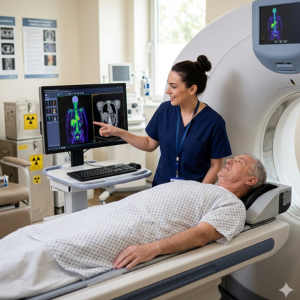
Nuclear medicine relies on highly advanced imaging modalities that provide detailed insights into physiological functions. Among these, Positron Emission Tomography (PET) and Single Photon Emission Computed Tomography (SPECT) remain the most widely used techniques. PET scans measure metabolic activity by detecting gamma rays emitted from positron-emitting tracers, which helps identify abnormal cellular activity. In contrast, Single Photon Emission Computed Tomography (SPECT) scans evaluate blood flow and tissue function by capturing gamma radiation directly from radiotracers.
Furthermore, hybrid imaging modalities like PET/CT and SPECT/CT use both anatomical and physiological information in a single scan. Consequently, clinicians have more insight into their diagnoses, leading to improved treatment and better patient results. Therefore, these novel imaging technologies stress the role of nuclear medicine in contemporary diagnostics and clinical decision-making.
Applications of Nuclear Medicine in Clinical Practice
Nuclear medicine plays a vital role in diagnosing and managing a wide range of medical conditions across multiple specialties. For instance, it is widely used in oncology to detect, stage, and monitor cancer progression effectively. In addition, nuclear medicine assists cardiologists by checking the flow of blood to the heart and diagnosing coronary artery disease. On the other hand, it is crucial in neurology because it helps diagnose conditions like Alzheimer’s disease, Parkinson’s disease, and other neurological disorders. Thus, nuclear medicine continues to expand its applications, offering reliable diagnostic solutions across various medical fields.
Advantages of Nuclear Medicine Over Conventional Imaging
Nuclear medicine offers several advantages that distinguish it from traditional imaging approaches in modern healthcare. First, it provides functional imaging, which reveals how organs perform rather than only displaying their anatomy. Second, nuclear medicine enables early detection of diseases, often identifying abnormalities before physical symptoms or structural changes appear.
Moreover, nuclear medicine imaging is very sensitive and accurate, reducing the risk of mistakes during diagnosis and helping with therapy planning. Another benefit of nuclear medicine techniques is their non-invasiveness and low patient preparation requirements. Another major benefit is its ability to diagnose as well as treat, especially in cancer treatments. Thus, nuclear medicine is an integrated technique that improves the effectiveness of diagnosis and treatment.
Safety and Efficiency in Nuclear Medicine
Safety remains a top priority in nuclear medicine, and modern practices ensure minimal radiation exposure during diagnostic procedures. Radiopharmaceuticals are carefully designed to decay quickly, thereby reducing potential risks to patients. Furthermore, technological developments have enhanced the efficiency of imaging, resulting in rapid imaging at higher quality. As an example, contemporary PET-CT equipment enables quick processes but with minimal radiation dose exposure. Moreover, strict regulatory standards and professional guidelines ensure that nuclear medicine procedures maintain high safety and quality benchmarks. Consequently, patients can benefit from accurate diagnostics with minimized health risks.
Future Trends in Nuclear Medicine
Nuclear medicine is advancing due to discoveries and innovations, which have increased its relevance in clinical practice. For instance, the creation of novel radio tracers makes it easier for doctors to target diseases at the molecular level. Furthermore, theranostics, which integrates therapy and diagnostics, represents a transformative advancement within nuclear medicine. This approach enables personalized treatment strategies tailored to individual patient conditions. Moreover, artificial intelligence and machine learning have been applied in nuclear medicine imaging techniques, increasing the level of efficiency and accuracy. It follows that these technologies will impact the future of medical imaging.
Emerging Outlook
Nuclear medicine has revolutionized diagnostic imaging by offering detailed insights into the body’s functional processes and disease progression. It enables early detection, precise diagnosis, and effective management of complex medical conditions. Furthermore, the increasing prevalence of cancers and heart disease cases has led to a heavy dependence on nuclear medicine around the world. As a result of technological improvements, nuclear medicine continues to play an important role in health care. As innovation continues, nuclear medicine will remain a cornerstone of modern diagnostic imaging, driving progress in precision medicine and improving global healthcare standards.