
Precision and visibility remain fundamental requirements in modern healthcare. As medical procedures become increasingly sophisticated, healthcare professionals require advanced tools that support accuracy, efficiency, and patient safety. Among these essential instruments, medical loupes have emerged as indispensable optical devices that enhance visualization during complex clinical procedures.
Medical loupes are specialized optical magnification devices worn by healthcare professionals, particularly surgeons and dentists, to improve visual acuity and ergonomic posture. These devices help clinicians perform intricate procedures with greater confidence while reducing physical strain associated with prolonged clinical work. Consequently, healthcare facilities and practitioners increasingly recognize their value in supporting both clinical excellence and workplace well-being.
Several healthcare trends drive the growing adoption of medical loupes. The rising prevalence of minimally invasive surgeries has increased the need for enhanced visualization during procedures. Similarly, work-related musculoskeletal disorders in physicians are gaining importance within medical institutions. As a result, the development of magnification technologies is one such vital element fulfilling both the precision and ergonomic aspects.
Understanding Medical Loupes
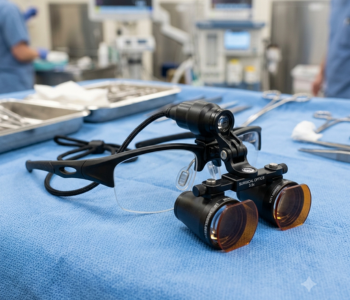
Medical loupes are wearable magnification systems designed to enlarge the clinician’s field of view during examinations, diagnoses, and treatments. Typically mounted on lightweight eyeglass frames, these devices provide magnified images, allowing healthcare professionals to observe fine anatomical structures with exceptional clarity.
Another difference between medical loupes and traditional magnifying instruments is that loupes facilitate binocular vision; hence, clinicians retain depth perception even when the working structure is enlarged. Consequently, distances and relationships between the objects can be judged more correctly by the practitioner performing intricate procedures. Many systems in medical loupes have built-in LED lighting to improve illumination on the working site, where the light could be minimal. Available in magnification levels ranging from 2.0x to 6.0x or higher, medical loupes accommodate diverse clinical requirements. Lower magnification provides a wider field of view, while higher magnification supports highly specialized procedures requiring exceptional detail.
Growing Demand Across Healthcare
The market for medical loupes continues expanding due to demographic and healthcare industry developments. The aging population in the United States increasingly requires complex medical and dental interventions. Consequently, healthcare professionals need high-precision optical aids that support superior treatment outcomes and procedural accuracy. In addition, the increasing use of minimally invasive techniques has increased the need for better visualization tools. Many of these procedures are performed in confined spaces, where visibility is limited. The advantages of medical loupes are that they allow clinicians to view important structures more clearly and accurately.
Healthcare organizations also realize the importance of protecting clinicians from occupational injuries. Neck, shoulder, and back disorders are frequently caused by healthcare professionals adopting uncomfortable postures during procedures. Medical and dental practices are therefore increasingly adopting ergonomic solutions like medical loupes.
Medical Loupes and the Expanding Dental Workforce
Dentistry represents one of the largest professional segments utilizing medical loupes. According to the American Dental Association, the United States dental workforce included 202,485 professionally active dentists in 2025. This substantial and growing workforce represents a significant user base for magnification technologies designed to improve clinical performance.
Today, dental professionals increasingly invest in medical loupes to enhance diagnostic accuracy and treatment quality while managing demanding patient schedules. Enhanced visualization enables dentists to identify subtle conditions earlier and perform procedures with greater precision. Consequently, magnification tools have become standard equipment in many modern dental practices.
In addition, the use of preventive dental care continues to rise throughout the United States. According to Benevis' November 2024 Dental Trends Report, the proportion of adults utilizing preventive dental care grew from 78% to 83% between 2022 and 2023. This growth creates a larger pipeline for restorative and specialty care needs and further enhances the demand for technologies capable of facilitating precise clinical interventions.
How Medical Loupes Improve Clinical Precision
Among the various clinical advantages provided by medical loupes, clinical precision continues to be one of the most important. During surgical and dental procedures, healthcare professionals often work with extremely small structures that require detailed visualization. The increased magnification afforded by medical loupes provides clinicians the ability to clearly visualize anatomical landmarks, tissue boundaries, and the intended area of treatment.
Moreover, improved visualization helps to improve hand-eye coordination during procedures. The treatment field is clear and visible, so clinicians can perform suturing, restorations, tissue manipulation, and other delicate tasks with much greater consistency. As a result, medical loupes play a role in better procedural outcomes and greater patient safety. Magnification also allows for more rapid and informed clinical decision-making. During tests and procedures, important details are visible that help healthcare professionals to spot abnormalities and treatment opportunities more efficiently.
Ergonomic Benefits for Healthcare Professionals
In addition to enhancing visualization, medical loupes offer significant ergonomic advantages. Many healthcare professionals experience chronic neck, back, and shoulder discomfort due to prolonged forward-leaning positions during patient care. When wearing accurately calibrated medical loupes, clinicians can work at an optimal working distance without compromising visual clarity. Practitioners are thus able to perform clinical procedures more naturally. Musculoskeletal strain is lessened, and this enables good occupational health. Additionally, the range of declination angles and working distances allows each user to achieve optimal positioning for their practice requirements. Therefore, many users state that they experience decreased fatigue and feel more comfortable after long periods in the clinic.
Economic Growth Supporting Equipment Adoption
The financial expansion of the dental industry further supports the adoption of medical loupes. National dental care expenditures increased 2.5% to $174 billion in 2024 from the previous year, according to the American Dental Association. The growth indicates continued investment in the sector and helps facilitate wider acquisition of advanced clinical equipment. As dental practices expand and become more advanced, dentists are looking for more technologies to increase efficiency, accuracy, and patient satisfaction. Hence, medical loupes are becoming increasingly popular as a useful investment with real clinical and ergonomic benefits. Healthcare providers are also aware that enhanced visualization can lead to higher-quality results and patient confidence. Thus, magnification systems are becoming essential components of modern treatment environments.
Strategic Outlook
The continued evolution of healthcare leads to an ever-increasing need for precision, efficiency, and ergonomics. Medical loupes play a critical role in meeting these demands by providing superior magnification, enhanced visualization, and improved clinician comfort. Increased demand is attributed to the rising number of health workers, enhanced adoption of preventative care practices, and increased expenditures on health care.
The growing trend in minimally invasive treatments and the growing number of patients needing medical support all contribute to the demand for medical loupes. Additionally, medical loupes offer increased diagnosis accuracy, precision of treatments, and well-being at work. Medical loupes are essential tools in delivering optimal treatment, better diagnosis, and patient care while maintaining physical health in day-to-day operations.