
The future of delivery isn’t coming; it’s about to show up at your doorstep. In a move that feels both inevitable and disruptive, Amazon is quietly redefining the rules of last-mile logistics. The confirmation of its Rivr acquisition isn’t just another tech headline; it’s a signal that the final frontier of delivery is finally being cracked. Sidewalks are becoming supply chains, robots are becoming couriers, and the line between human intuition and machine precision is starting to blur in ways we’ve never seen before.
For years, Amazon dominated inside the warehouse. Now, it’s stepping outside, onto the streets, into neighbourhoods, and directly to your door. This isn’t just innovation; it’s a calculated leap toward solving the final meter problem that has long challenged the logistics world. In this blog, we will uncover what Amazon’s Rivr acquisition really means, explore how doorstep delivery robots could transform last-mile logistics, and analyze whether this bold push into automation will redefine the future of global commerce or face unexpected roadblocks along the way.
Amazon’s Strategic Move into Doorstep Robotics
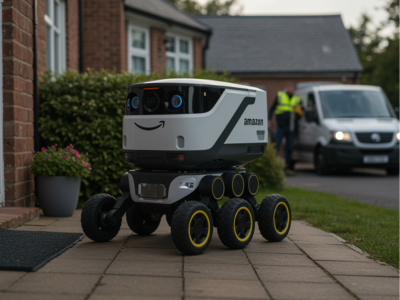
In a recent communication to third-party contractors, Amazon detailed its plans for the Rivr integration. The company intends to test how Amazon’s doorstep delivery robots can support existing delivery networks. These sophisticated machines are designed to transport packages from a delivery vehicle directly to a porch. This specific task has traditionally been the sole responsibility of human drivers, often involving physical strain and navigational hurdles.
Amazon noted that these robotic delivery systems possess immense potential to improve safety outcomes. By utilizing AI-powered robots for the final stretch of the journey, the company can mitigate risks. These include heavy lifting, repetitive motion injuries, and navigating hazardous suburban terrain. Most importantly, the company stressed that these systems are meant to work alongside humans. This collaborative approach defines the next era of robot-assisted delivery.
Inside the Amazon Rivr Acquisition
While the specific financial terms remain a closely guarded secret, the deal fits a clear pattern of Amazon robotics acquisitions. Rivr is renowned for its unique hybrid design: four-legged robots equipped with wheels. This animal-inspired engineering allows for incredible stability and agility in unpredictable outdoor environments. Amazon informed its partners that the Amazon robotics unit sees four primary areas of impact:
- Agile Transport: Moving parcels from the van to the door without human intervention.
- Variable Terrain: Mastering stairs, curbs, and uneven driveways with ease.
- Physical Relief: Dramatically reducing the daily mechanical strain on human drivers.
- Efficiency Gains: Shortening the time a delivery van spends idling at the curb.
These features support the goal of building autonomous delivery robots that augment, rather than replace, the current workforce.
Why Doorstep Delivery Robots Matter for Amazon
The integration of Rivr technology into the fleet reveals several long-term corporate priorities. First, there is a focus on delivery driver safety technology. Reducing fatigue and injury is a critical objective for the Amazon robotics unit. When a robot handles the heavy lifting, the human driver stays fresher and more focused throughout their shift.
Second, this move optimizes last mile delivery solutions. The last mile is famously the most expensive and complex portion of the supply chain automation process. Smart delivery robots can navigate dense urban centers or long rural driveways where a van might struggle. This leads to a better customer experience through consistent and reliable fulfillment. By investing early, Amazon secures its leadership in the future of delivery landscape.
Robotics as a Core Pillar of Amazon’s Logistics Strategy
Amazon's commitment to the robotics startup acquisition model began in earnest in 2012. After the purchase of Kiva Systems, the company revolutionized its internal operations. Today, over one million robots are deployed across the globe. This massive base of industrial robotics proves that Amazon is the world leader in automated infrastructure. The Rivr deal is the natural evolution of this history. It moves supply chain automation from the controlled environment of the warehouse to the chaotic world of the street. It represents a decade of steady progression toward a fully AI-powered logistics network.
A Decade of Milestones:
- 2012: Kiva Systems acquisition launches the internal robotics revolution.
- 2022: The $1B Industrial Innovation Fund begins backing logistics startups.
- 2024: Scaling of autonomous mobile robots reaches peak efficiency.
- 2026: Rivr acquisition brings robot-assisted delivery to the doorstep.
How Rivr Fits Into Amazon’s Delivery Vision
The form factor of the Rivr robot is its secret weapon. Unlike wheeled pods that are stuck on flat sidewalks, these four-legged machines can climb. They can navigate a set of porch steps or a steep, icy driveway. This capability is vital because the doorstep is often the hardest logistical barrier to cross.
By closing this gap, the Amazon Rivr acquisition provides a solution that drones or vans cannot offer alone. This creates a more predictable service window and enhances compliance with safety standards. For the consumer, it means packages are placed exactly where they want them, regardless of the architectural challenges of their home.
The Fusion of AI, Robotics, and Last Mile Logistics
This move showcases the convergence of AI in logistics and physical automation. Rivr’s robots rely on advanced machine learning to survive the "wild" environment of a suburban neighborhood. Autonomous distribution systems are undergoing a profound evolution as sophisticated detection capabilities allow for the real-time avoidance of dynamic obstacles, including household pets, stationary objects, and moving vehicles.
This precision is supported by advanced environment mapping, which constructs three-dimensional models of every transit point to ensure future navigational accuracy. Furthermore, refined path planning protocols determine the most efficient routes to preserve critical battery reserves. This technical sophistication extends to the physical handling of goods, where systems now autonomously adjust grip and balance based on the specific weight and dimensions of each parcel. This contributes to a broader data-driven framework. It is the heart of the e-commerce logistics automation revolution.
Scaling for the Future: Early Stages of Testing
Amazon has been transparent with its partners about the timeline. The company is currently in the "early stages" of this journey. This involves rigorous field testing with live delivery teams. The goal is to collect real-world data to improve the robotic delivery systems before a global rollout. They are focused on how the technology performs in extreme climates. Whether in the heat of Arizona or the snow of Maine, smart delivery robots must be resilient. This deliberate approach shows that Amazon respects the complexity of the last mile delivery solutions they are building.
Impact on the Autonomous Delivery Robots Industry
The Rivr acquisition has sent a clear signal to the rest of the logistics technology innovation sector. When a giant like Amazon adopts a specific form factor, it validates the entire commercial category. The retail landscape faces a seismic shift as major entities consolidate power within the robotics sector, triggering a fierce race for technical acquisitions to maintain market relevance. This influx of capital is poised to double the acceleration of last-mile delivery automation, rapidly dismantling traditional logistics frameworks. Consequently, the role of the delivery professional is transitioning into a fleet supervisor, shifting from manual operation to high-level technical oversight. As the sector matures, design and functional parameters are expected to converge toward a strict standardization dictated by the primary market leaders.
Industry Evolution and Future Path
The rise of Amazon's doorstep delivery robots is not just about cool gadgets. it is a fundamental redesign of how goods move through our world. By combining AI in supply chain management with agile hardware, Amazon is removing the final friction points of online shopping. As we look toward the future of delivery, the integration of humans and robots is inevitable. The Rivr acquisition ensures that Amazon stays at the steering wheel of this transformation. Whether it is through improved safety or faster fulfillment, the impact of these robots will be felt on every doorstep in the country.