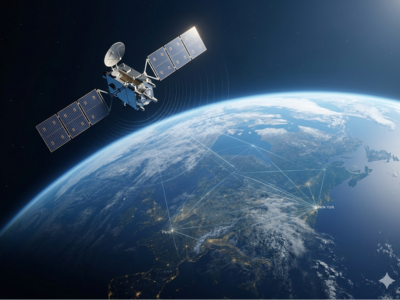

The race to dominate space is no longer science fiction. It is unfolding quietly above us. Low Earth Orbit satellites are rapidly becoming the invisible backbone of the global digital economy. What once seemed like an experimental frontier is now attracting billions in capital, fierce competition, and bold technological ambition. In this blog, we will explore how Low Earth Orbit (LEO) satellites are transforming global connectivity, driving investment trends, enabling orbital data centers, and reshaping the future of commercial space infrastructure. We will also uncover how companies like SpaceX, Amazon, and Nvidia are competing to build the next digital layer in orbit.
LEO Satellite Market Snapshot
The LEO Satellite Market is experiencing strong growth driven by rising demand for connectivity and technological advancements. Recent studies highlight that the market is estimated to reach US$35.44 billion by 2034. Increasing deployments from major players are expanding global coverage and improving service reliability. Market performance is supported by innovations in AI, satellite manufacturing, and launch capabilities. As new constellations come online, the industry will continue to evolve rapidly. This growth positions Low Earth Orbit satellites as a cornerstone of future digital infrastructure.
Investment Trends in LEO Satellite Infrastructure
Investment in Low Earth Orbit satellites has surged at an unprecedented pace. Governments and private investors now see space as a critical infrastructure layer, not a distant experiment. Billions are flowing into satellite manufacturing, launch systems, and advanced communication technologies. The US leads global LEO deployment with over 11,000 satellites as of early 2026, serving internet, defense, and imaging needs. The rise of LEO satellite investment trends reflects growing confidence in long-term returns. Investors are backing LEO satellite constellations as scalable platforms that can support global connectivity from space. This shift mirrors early internet expansion, where infrastructure investments created massive long-term value. The LEO Satellite Market is expanding rapidly due to increasing demand for high-speed connectivity and real-time data processing. As deployments accelerate, companies are positioning themselves to dominate this next phase of digital infrastructure growth.
How LEO Satellites Are Transforming Global Connectivity
Low Earth Orbit satellites are redefining how the world connects. Their proximity to Earth reduces latency significantly, enabling faster communication than traditional satellites. This makes them ideal for real-time applications such as video streaming, remote work, and emergency response. LEO satellite constellations create a dynamic network that continuously adjusts coverage. This ensures reliable service across remote regions, oceans, and underserved areas. As a result, global connectivity from space is becoming a practical reality rather than a distant vision. This transformation is especially critical for developing regions. Reliable internet access can unlock education, healthcare, and economic opportunities. As adoption grows, Low Earth Orbit satellites will become essential to digital inclusion worldwide.
SpaceX Starlink and the Race for Orbital Data Centers
The SpaceX Starlink network leads the current LEO revolution. With thousands of satellites already in orbit, it has set the benchmark for large-scale deployment. Starlink’s rapid expansion demonstrates how quickly LEO satellite constellations can scale. However, the next frontier goes beyond connectivity. The concept of orbital data centers is gaining momentum. These space-based systems could process data directly in orbit, reducing reliance on Earth-based infrastructure. This shift opens new possibilities for AI-driven analytics, climate monitoring, and global communications. As competition intensifies, companies are racing to build not just networks, but entire computing ecosystems in space.
Commercial Opportunities in the Emerging Space Economy
Low Earth Orbit satellites are unlocking a wide range of commercial opportunities. Businesses are exploring new applications that extend far beyond traditional telecommunications.
Key opportunities include:
- Satellite-based broadband services for remote regions
- Space-powered cloud computing platforms
- Earth observation for agriculture and climate monitoring
- Satellite-to-device communication for mobile networks
- Autonomous navigation and logistics support
These developments highlight the rapid growth of commercial space infrastructure. The expansion of the privately funded space economy reflects strong confidence in long-term profitability and innovation.
Nvidia and AI Computing in Orbit: The Next Frontier
The role of Nvidia in space is becoming increasingly significant. Nvidia AI in orbit represents a major leap toward intelligent satellite systems. These systems can process data directly in space, reducing delays and improving efficiency. AI-powered satellites can analyze images, detect patterns, and make decisions in real time. This capability transforms satellites into active computing nodes rather than passive transmitters. As AI and space technology converge, Low Earth Orbit satellites will play a critical role in supporting advanced digital ecosystems. This integration marks the beginning of a new era in space-based computing.
Amazon LEO and Project Kuiper Satellite Deployment Plans
Amazon is aggressively expanding its presence in space through Amazon Project Kuiper satellites. The company plans to deploy thousands of satellites to compete with existing networks. Project Kuiper aims to deliver high-speed internet while integrating with Amazon’s cloud services. This creates a powerful ecosystem that connects space infrastructure with enterprise applications. Amazon’s strategy highlights the growing importance of Low Earth Orbit satellites in global business operations. As deployment accelerates, competition among major players will drive innovation and improve service quality.
Regulatory Challenges for Commercial LEO Operations
The rapid expansion of Low Earth Orbit satellites has introduced complex regulatory challenges. Governments must now manage satellite traffic, spectrum allocation, and orbital sustainability. Regulatory challenges for LEO satellites include preventing collisions, reducing space debris, and ensuring fair access to orbital resources. Existing frameworks were not designed for such large-scale deployments. As more companies enter the space economy, updated regulations will become essential. Balanced governance will ensure long-term sustainability while supporting innovation in commercial space infrastructure.
The Rise of Privately Funded Space Infrastructure
Private investment is reshaping the global space landscape. The rise of the privately funded space economy has accelerated innovation and reduced barriers to entry. Startups and tech giants are now leading the charge in satellite development and deployment. This shift allows faster experimentation and rapid scaling of new technologies. Low Earth Orbit satellites are at the center of this transformation, acting as the foundation for next-generation digital services. As private funding continues to grow, space will become more accessible and commercially viable. This marks a significant departure from the traditional government-led model of space exploration.
What Lies Ahead
A quiet revolution is unfolding above the Earth. Low Earth Orbit satellites are no longer just tools for communication. They are becoming the foundation of a new digital era. From enabling global connectivity from space to powering orbital data centers, their impact is far-reaching. Companies like SpaceX, Amazon, and Nvidia are shaping this transformation with bold strategies and massive investments. As the industry evolves, the convergence of AI, connectivity, and space infrastructure will redefine how the world operates. The question is no longer whether space will influence our daily lives. The real question is how quickly Low Earth Orbit satellites will become the invisible engine powering everything we do.