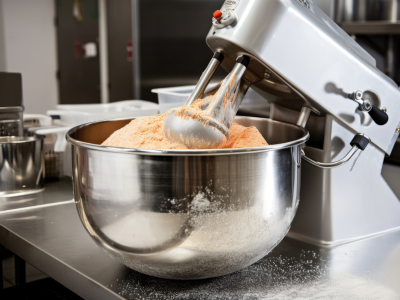

The modern food manufacturing landscape undergoes rapid transformation every single day. Global demand for processed foods continues to climb at an unprecedented rate. Consequently, manufacturers must find innovative ways to scale their production without sacrificing quality. At the heart of this industrial evolution lies a critical piece of technology: Industrial food mixers. These robust machines serve as the backbone of high-volume facilities across the globe. They ensure that every batch of product meets the rigorous standards of today's discerning consumers. From the bustling bakeries of Europe to the sprawling beverage plants in Asia, high-capacity mixing solutions drive the industry forward.
The Global Pulse of Food Manufacturing
The global food blender and mixer market is currently witnessing a significant surge. Market analysts project that the market will experience robust growth by 2034. This growth reflects a clear shift toward automation and large-scale efficiency. Manufacturers no longer rely on small-batch processes to meet international needs. Instead, they invest in high-capacity Industrial food mixers to achieve economies of scale. These machines allow for the seamless integration of raw ingredients into finished goods. Furthermore, the rise of the middle class in emerging economies fuels this demand. People want consistent, safe, and high-quality food products available on every shelf.
Enhancing Throughput with Advanced Mixing Technology
Productivity is the primary metric for success in any industrial setting. High-capacity mixers allow plants to process thousands of kilograms of material every hour. This level of output is simply impossible with manual or small-scale equipment.
- Reduction in Cycle Times: Modern Industrial food mixers utilize optimized blade designs. These designs create intense mechanical energy to blend ingredients in record time.
- Continuous Processing: Many facilities now transition from batch mixing to continuous mixing. This shift ensures a steady stream of product moves through the production line without interruption.
- Minimized Downtime: Large mixers often feature Clean-in-Place (CIP) systems. These automated cleaning cycles reduce the time spent on sanitation between different product runs.
By integrating these advanced systems, food processors can maximize their daily yield. They effectively lower the cost per unit while meeting high-volume orders from global retailers.
Achieving Unwavering Product Consistency
Consistency is the hallmark of a successful food brand. A consumer expects the same taste and texture whether they buy a product in New York or Tokyo. Industrial food mixers play a vital role in maintaining this brand promise.
Precision in Ingredient Dispersion
Large-scale mixers are engineered for total uniformity. They prevent the hot spot effect where certain ingredients clump together. Whether it is fortifying flour with vitamins or blending spices into meat, precision is mandatory. Industrial food mixers use sophisticated agitators to ensure every milligram of an additive is distributed evenly. This level of accuracy protects the manufacturer from quality claims and regulatory non-compliance.
Stability of Emulsions and Suspensions
Many food products, such as sauces and dressings, require stable emulsions. High-shear Industrial food mixers break down oil droplets into microscopic sizes. This process creates a smooth texture that remains stable throughout the product's shelf life. Without high-capacity mixing, these complex formulations would likely separate. Such failures result in massive product waste and financial loss for the company.
The Role of Automation and Smart Controls
The latest generation of Industrial food mixers features advanced digital controls. These smart mixers allow operators to program exact parameters for every recipe.
- Recipe Management: Digital systems store hundreds of unique mixing profiles. This ensures the mixer applies the correct speed and duration for every specific product.
- Real-Time Monitoring: Sensors track temperature, viscosity, and motor torque during the mixing cycle. If the system detects a deviation, it adjusts automatically to save the batch.
- Data Traceability: In the event of a food safety audit, these mixers provide a digital paper trail. Manufacturers can prove that every batch was mixed according to safety standards.
Automation reduces the risk of human error significantly. It empowers Industrial food mixers to perform complex tasks with repetitive perfection. Consequently, the reliance on skilled labor decreases while overall safety increases.
Meeting Rigorous Global Safety Standards
Food safety is a non-negotiable priority in the international market. High-capacity Industrial food mixers are designed with hygienic engineering at their core. Manufacturers typically use high-grade 316L stainless steel for all contact parts. This material resists corrosion and prevents bacterial growth.
Furthermore, the design of modern Industrial food mixers eliminates dead zones. These are areas where food particles could get trapped and rot. By ensuring a completely smooth interior, these machines support the highest levels of sanitation. This focus on hygiene is essential for passing international certifications like GFSI or HACCP.
Future Trends in the Mixer Market
The industry is moving toward even greater efficiency and sustainability. We expect to see more energy-efficient motors in the next generation of Industrial food mixers. These motors will reduce the carbon footprint of large-scale plants. Additionally, AI-driven predictive maintenance will become the standard. These systems will notify managers before a component fails. This proactive approach will virtually eliminate unplanned downtime in the food processing line.
Conclusion: The Path to Industrial Excellence
The food processing industry stands on the threshold of a new era. Productivity and consistency are no longer just goals; they are requirements for survival. Industrial food mixers provide the technological foundation to meet these demands. They offer the speed required for global distribution and the precision needed for consumer safety. By investing in high-capacity mixing solutions, manufacturers secure their place in the future of food. These machines transform raw ingredients into the consistent, high-quality products that feed the world.