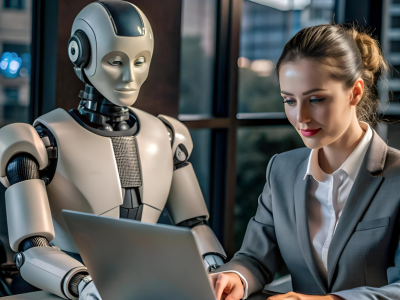

The integration of corporate artificial intelligence is accelerating at an absolute breakout pace. For many years, enterprise leaders and technology developers struggled to balance pure automation with human workplace talent. Today, managing highly complex digital systems requires a unified approach to everyday business operations. A major turning point occurred this week with a massive financial announcement in the corporate development space. This progress signals a historic victory for companies deploying a strategy built around Responsible Human-Led AI across major industries. By focusing on people alongside modern algorithms, forward-thinking organizations can successfully eliminate severe deployment risks. These emerging strategic frameworks allow executive teams to upgrade operational efficiency while protecting their valuable internal workplace culture.
Human-Led AI Adoption in Financial Services
The market for intelligent digital solutions in the United States is expanding rapidly as corporate boards demand safer automation. This strong growth trend shows that top American corporations are shifting heavily toward people-focused technology frameworks. By embedding stable management guardrails directly into their daily routines, U.S. executive teams are driving incredible human-led digital transformation forward. As keeping up with shifting international compliance rules is highly critical across North America, local firms are modernizing their operations right now. Currently, the US maintains dominance with the largest share in the global enterprise AI software market, serving as the primary launchpad for automated commercial networks.
Responsible AI Transformation in Large Enterprises
Succeeding with modern enterprise tools requires corporate groups to look far beyond simple software installations. Relying unthinkingly on automated code can create severe data errors and compromise sensitive client trust. True corporate safety requires a structured, responsible AI adoption plan that respects human expertise at every level. This is exactly where human oversight completely changes how a large organization utilizes complex digital models. Instead of replacing skilled personnel with cold algorithms, the system actively amplifies existing human capability. It ensures that experienced managers remain fully in control of critical company workflows, shielding the business from unexpected errors.
Future of Work Alliance for AI Governance
The absolute biggest hurdle for modern corporate scale involves managing massive data processing safely across multiple distinct departments. Many executive teams end up stuck due to their current software lacks transparent oversight rules. To solve this bottleneck, global financial giant BNY teamed up with the University of Manchester to launch the Future of Work Alliance. This five-year, five-million-pound initiative focuses entirely on designing and scaling trusted frameworks for automated data environments. By running live operational challenges through structured research projects, this group helps clear a smooth path for enterprise AI governance. It bridges the gap between raw academic discovery and everyday business management needs.
AI Workforce Development and Executive Education
Upgrading a massive multinational corporation traditionally required spending millions on standard software retraining courses that ignored management oversight. These generic training programs often fail as they do not teach leaders how to govern automated systems safely. The rollout of custom university business programs completely flips this outdated training narrative on its head. Focused AI executive education paths ensure that corporate directors learn how to manage complex, data-intensive workplace changes confidently. This targeted learning helps organizations build reliable internal protocols to handle the long tail of technological complexity. It empowers leadership teams to manage automated transitions smoothly without experiencing painful disruptions to their core business lines.
University and Industry Collaboration for Ethical AI
When you are managing a major financial platform, you cannot afford to let unverified algorithms make blind choices. The newest corporate safety models eliminate this operational risk by establishing a deep academic and industry AI partnership. Through this partnership, leading scientists can experiment with digital applications within the sandbox environment of businesses. This innovative arrangement enables the engineers to develop strong models that ensure any AI implementation is done responsibly and without any risk. Each new application for business should meet specific compliance criteria and transparency measures before its implementation. The validation procedure guarantees that all automated processes are reliable and consistent with company policy.
Human-Centered AI Innovation in Manchester
Investing in overly rigid automated tools frequently results in slow adaptation speeds and massive operational friction for global enterprises. Forward-thinking executives are quickly moving away from entirely automated setups and embracing flexible AI innovation in financial services. This change in strategy can be clearly seen in the example of Manchester, where the city quickly emerges as one of the best places to test new technological advancements. It's due to the abundant availability of talent here, and it enables foreign businesses to implement novel strategies that blend effortlessly with human resources. This creates a fantastic platform for organizational change through AI.
AI Skills, Research, and Digital Transformation Programs
Supercharging your daily organizational productivity requires a unified corporate strategy where training programs effortlessly match evolving digital capabilities. Modern business development achieves this by focusing heavily on comprehensive AI skills development across the entire workforce. Such a combined approach ensures that regular workers develop the necessary expertise needed to work with the advanced systems safely, in addition to algorithms. Postgraduate internships, along with research tasks, help teams get hands-on experience working on actual organizational data. The ongoing learning process has helped organizations become better prepared for the adoption of new tools without any delay.
The Future Outlook for Responsible Human-Led AI
The rapid evolution of independent digital tools points directly toward a future where human ingenuity guides automation seamlessly. Embracing a comprehensive digital workforce transformation strategy allows corporate directors to future-proof their operations against sudden market disruptions. With the implementation of a responsible human-led AI approach, your organization can be certain that sustainable and scalable growth is just around the corner. The new approach will rapidly evolve into the norm for leading enterprises of the world that want to operate on the cutting edge of business innovation. The age of considering automation merely an alternative way of getting rid of employees has come to an end.