
In the modern digital economy, data is the lifeblood of nearly every organization. You generate it, store it, share it, and rely on it to make strategic decisions. However, as data volumes grow and environments become increasingly complex, one crucial question emerges: Do you know exactly where your sensitive data is and who has access to it
Far too often, organizations assume that existing cybersecurity measures are enough. Unfortunately, the real threat lies not just in external attacks but in a lack of internal visibility and governance. So, what does it take to truly secure your most sensitive information
The Growing Risk of Unstructured Data
Let’s begin with unstructured data. This includes documents, emails, spreadsheets, chat messages, media files, and more. Unlike structured data stored in databases, unstructured data lives across cloud drives, collaboration tools, personal devices, and archived systems.
Now ask yourself:
- How many duplicate files exist across your network
- Could sensitive customer data be hiding in overlooked folders or shared inboxes
- Are former employees still able to access old project files
If you can’t answer these questions confidently, you’re not alone. Many enterprises lose track of where unstructured data resides. As a result, they fail to assess its sensitivity, making it nearly impossible to protect. Each unknown file becomes a potential breach point, expanding your organization’s attack surface.
Over-Permissioned Access Is a Silent Threat
Another major issue stems from overly broad access permissions. While it’s important to give employees the tools and data they need to do their jobs, access often persists long after it’s needed. For example, an employee who transitions to a new role may still retain permissions from their previous position. Similarly, contractors and vendors frequently maintain data access beyond the duration of their contracts.
Although these scenarios may seem minor, they introduce serious risks. Every additional access point is a potential vulnerability. Without consistent oversight, your data becomes exposed to people who no longer need it, or worse, shouldn’t have had it in the first place.
To mitigate this, you must enforce the principle of least privilege. That means limiting access to only what’s necessary based on roles and responsibilities. More importantly, it requires frequent reviews and automation to keep access levels up to date.
Compliance Is Now a Business Imperative
In addition to security concerns, regulatory compliance adds another layer of complexity. Laws like the General Data Protection Regulation (GDPR), California Consumer Privacy Act (CCPA), and Health Insurance Portability and Accountability Act (HIPAA) have transformed data governance from a best practice into a legal requirement.
These regulations demand that you:
- Know exactly what personal or sensitive data you store.
- Demonstrate how it is protected.
- Provide access or deletion upon user request.
However, achieving this level of compliance without proper visibility is extremely difficult. If you can’t locate all instances of customer data or show who accessed it and when, you could face stiff penalties and reputation damage.
Moreover, auditors now expect organizations to prove they’ve applied consistent security controls, regardless of where data lives, on-prem, in the cloud, or within third-party systems.
The Visibility Gap: Why Traditional Tools Fall Short
Despite the growing urgency, many organizations still rely on outdated or manual processes to manage their data. Traditional security tools often focus on perimeter defense, firewalls, intrusion detection, and antivirus software, while leaving internal risks unchecked.
That’s a problem because sensitive data rarely stays confined to one place. It’s copied, shared, and edited constantly. Without tools that can track and classify data wherever it resides, you’re left in the dark.
So, what’s the solution? Organizations need a data-centric approach to security, one that emphasizes visibility, control, and automation.
A Three-Step Framework to Secure Your Data
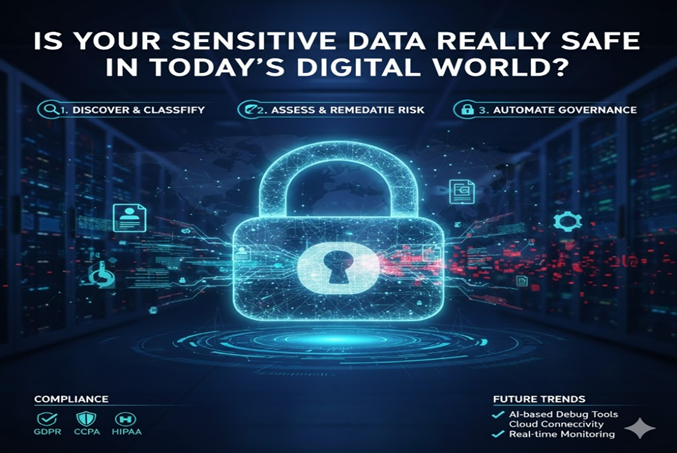
To truly protect your organization’s sensitive data, consider adopting the following three-step model:
1. Discover and Classify
Start by using advanced tools, ideally powered by machine learning, to scan your environment and identify sensitive information. These solutions should analyze not just file names and metadata, but also the content itself.
Classifying data based on sensitivity (e.g., financial records, customer PII, IP, health records) allows you to prioritize protection efforts.
2. Assess and Remediate Risk
Once you have visibility, assess how exposed your data is. Identify where access permissions are too broad, which files are shared externally, and where compliance risks exist. Use this insight to prioritize remediation based on severity and impact.
3. Automate Governance
Finally, implement automated policies to maintain security. This includes:
- Automatically revoking stale access
- Enforcing least-privilege permissions
- Monitoring policy violations in real-time
- Generating reports for audits
With automation, you reduce human error and ensure that security protocols adapt as your data environment evolves.
Why Strategic Partnership Matters
Although implementing a comprehensive data protection strategy might seem overwhelming, you don’t have to go it alone. Working with experienced cybersecurity partners can dramatically accelerate your progress.
These experts can help you:
- Design a governance model tailored to your unique data landscape
- Implement best-in-class tools for scanning, classification, and monitoring
- Align your practices with regulatory requirements
- Train teams to sustain a secure data culture
Ultimately, the right partner can turn data protection from a reactive task into a proactive advantage.
Final Thoughts: Act Before It’s Too Late
Every day, more of your organization’s data is created, shared, and stored in ways that introduce risk. Yet far too many businesses delay action until a breach occurs or an audit exposes gaps.
Don’t wait. Ask yourself:
- Do we have full visibility into our sensitive data
- Are our access permissions tightly controlled
- Can we demonstrate compliance, confidently and consistently
If the answer to any of these is “no,” now is the time to act.
Secure data isn’t just hidden data; it’s data you control, monitor, and protect.