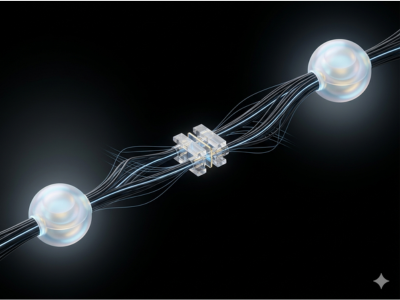

The Cisco Universal Quantum Switch marks a big step toward practical quantum networks. In its first announcement, Cisco showed how quantum systems can finally connect reliably. This research prototype solves a long-standing problem in quantum networking by letting different quantum devices communicate without losing information.
Cisco introduced the switch on April 23, 2026, at its San Jose headquarters. The company described it as a working prototype rather than just a concept. Researchers designed the switch to route quantum information at room temperature, using the same telecom fiber as the internet.
Quantum computers encode information in different ways, which makes it hard for systems with different formats to communicate securely. Cisco’s quantum switch solves this by translating signals between formats. Its patented quantum conversion engine handles the process and keeps the original information secure during routing.
The switch supports several encoding methods, such as polarization encoding for quantum signals. It also works with time-bin, frequency-bin, and path encoding. This flexibility allows quantum hardware from different vendors to work together.
Preliminary results have been encouraging. According to Cisco scientists, there was less than a four percent loss of information when switching, enabling the preservation of quantum entanglement stability. The switch can change its connections within one nanosecond and consumes less than a milliwatt of power per action.
Cisco developed the quantum switch as part of its larger strategy towards quantum networking. For Cisco, improved connectivity is crucial for scaling quantum computers. As individual devices are not powerful enough yet, networking enables several systems to act as one unit.
In the middle of Cisco’s announcement, Quantum Networking Adoption strategies continue gaining attention worldwide. Governments and enterprises seek secure quantum communication protocols. Many organizations now explore distributed quantum computing rather than single devices. Vendors focus on systems that scale across locations. Cisco’s approach supports this direction by enabling flexible connections. Room-temperature operation reduces deployment barriers significantly. Existing fiber support lowers cost and complexity. The US accounts for the largest share of the global market. As a result, early adoption often starts with U.S. research networks and labs.
Cisco leaders described the breakthrough as foundational. Vijoy Pandey, who leads Cisco’s emerging technologies group, called it a pivotal moment. He said true scalability depends on connecting quantum systems and emphasized that this is only the beginning.
Cisco’s prototype relies on an electro-optic quantum switch design. This enables low-latency quantum switching for future networks. The design keeps quantum fidelity intact during routing. Such performance remains essential for real-world quantum network architecture.
Cisco made the switch at its Santa Monica quantum laboratories, where it has worked on both the hardware and the software of the quantum computer. This switch can be used together with the quantum entanglement chip and the network-aware quantum compiler made by Cisco. Thus, Cisco will have a complete solution stack including hardware, routing, and software control over applications.
The change is also good for current investments. Companies can combine quantum providers in their operations. There will be no single ecosystem dependence for businesses. This can encourage rapid developments in the quantum sector. This development holds significant meaning for America. American research institutions frequently initiate quantum network experiments. This development can expedite the construction of the country's quantum internet framework.
The US continues to lead as the dominant player based on market share, which makes the scalability of quantum technology essential at home. The quantum network switch from Cisco fits well into national objectives for security and development. It was also emphasized that the switch can operate within the current telecommunication fiber network without any special cooling mechanism.
In future tests, Cisco intends to add functionality through the time-bin and frequency-bin modes in order to make it even more interoperable. Each new step takes the network closer to practical use in the world of quantum technology. According to industry experts, no other product today is able to do what Cisco's quantum switch does, combining all of the main quantum encodings in one product.
Ultimately, the Cisco Universal Quantum Switch represents more than a lab success. It shows how quantum computing networks may soon operate. By preserving information across systems, Cisco helps unlock the promise of quantum communication. The path toward a connected quantum future now looks clearer.